

AMRULLAH, A. SAFIRAH AQILAH (2026) Pengaruh Variasi Konsentrasi Lipid Cair terhadap Sifat Fisik, Efisiensi Penjerapan, dan Kapasitas Pemuatan Rifampisin pada Nanostructured Lipid Carrier Berlapis Hyaluronic Acid=The Effect of Liquid Lipid Concentration Variation on the Physical Properties, Entrapment Efficiency, and Loading Capacity of Hyaluronic Acid-Coated Rifampicin Nanostructured Lipid Carriers. Skripsi thesis, Universitas Hasanuddin.
![[thumbnail of Cover]](/57112/5/N011221041-%20Sampul.jpg)
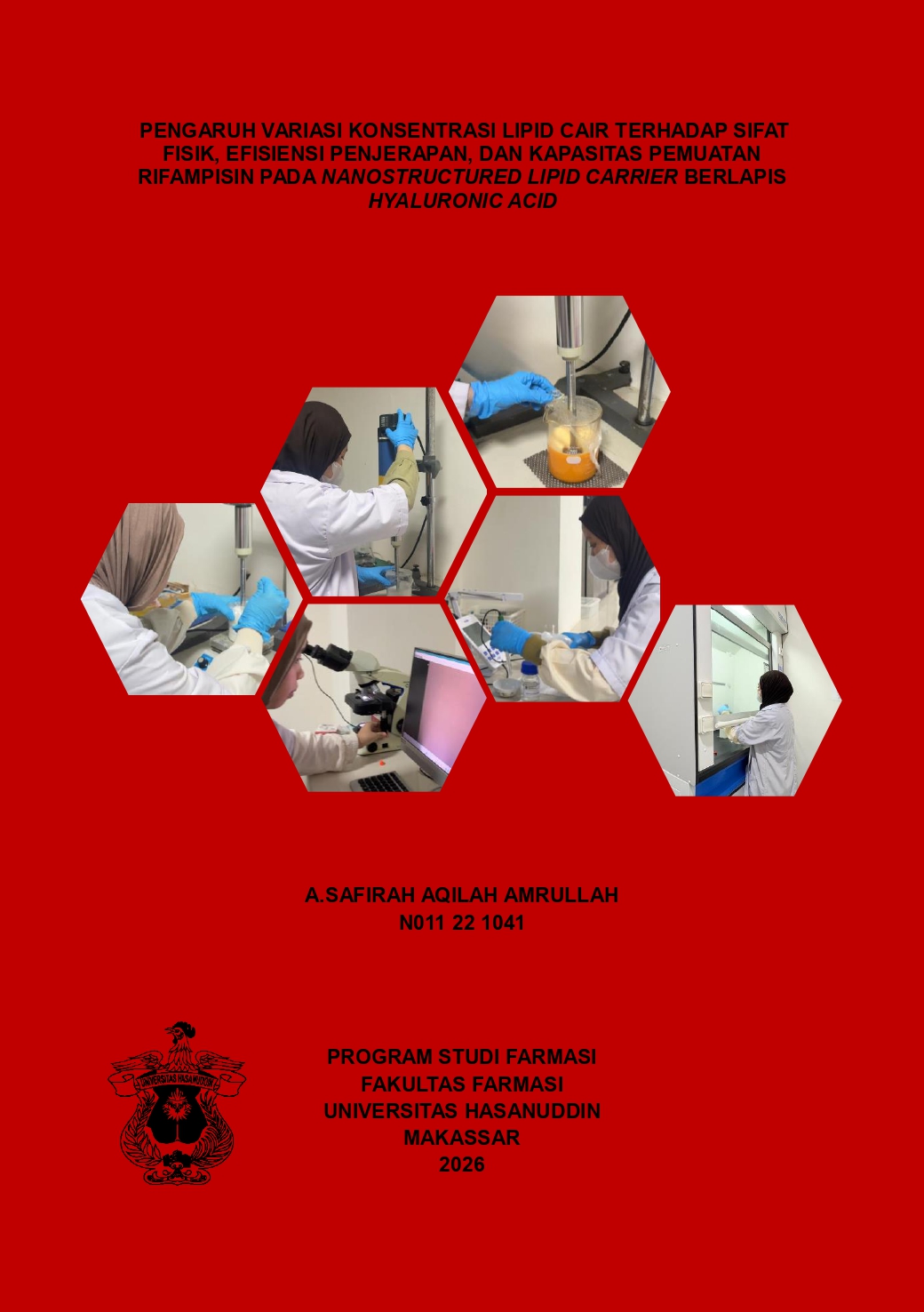
N011221041- Sampul.jpg
Download (396kB) | Preview
![[thumbnail of BAB I-II]](/style/images/fileicons/text.png) Text (BAB I-II)
Text (BAB I-II)
N011221041-1-2.pdf
Download (277kB)
Text (DAPUS)
N011221041-dp.pdf
Download (278kB)
Text (FULL TEKS)
N011221041-fullll.pdf
Restricted to Repository staff only until 3 February 2028.
Download (3MB)
Abstract (Abstrak)
ABSTRAK Penyakit tuberkulosis limfadenitis (LTB) merupakan infeksi tuberkulosis ekstrapulmoner oleh Mycobacterium tuberculosis yang menyerang kelenjar getah bening dengan kasus tertinggi 35-40%. Di dunia, tercatat 8,16 juta kasus tuberkulosis pada tahun 2023 dan diperkirakan akan terus meningkat hingga tahun 2035 mencapai 13,06 juta yang di antaranya 1,24 juta kasus LTB. Antibiotik paling poten yang digunakan sebagai kunci terapi tuberkulosis dan menjadi lini pertama pengobatan sekarang adalah rifampisin (RIF), bekerja secara efektif menghambat RNA polymerase bakteri sehingga bakteri tidak dapat bereplikasi. Namun, RIF memiliki kelarutan yang rendah (log P 1,09) sehingga menyebabkan akumulasi obat yang terbatas pada target kerja. Riset ini bertujuan mengembangkan penghantaran RIF dalam bentuk nanostructured lipid carrier dengan pelapisan hyaluronic acid (RIF-NLC/HA) yang menghasilkan partikel obat < 200 nm dan secara spesifik berikatan dengan makrofag. Untuk memaksimalkan penghantaran dicetak menjadi dissolving microneedle (DMN) sehingga obat dapat langsung berpenetrasi menembus epidermis kulit. Formula RIF-NLC/HA dibuat menggunakan metode high shear homogenization dengan memvariasikan konsentrasi asam oleat. Adapun formula DMN dibuat menggunakan metode cetak tuang dengan variasi polimer PVP (polivinil pirolidon) dan PVA (polivinil alkohol). Formula kemudian dikarakterisasi secara fisika kimia dan dievaluasi melalui uji profil pelepasan secara in vitro, uji permeasi secara ex vivo, uji farmakokinetika secara in vivo, dan diuji keamanannya melalui uji hemolisis serta potensi iritasi. Keseluruhan hasil data dianalisis secara statistika dalam bentuk grafik juga tabel. Hasil karakterisasi menunjukkan formula RIF-NLC/HA-DMN 1 adalah formula paling optimal dengan variasi asam oleat 60 mg dengan perbandingan PVA dan PVP sebesar 2:3. Hal ini ditandai oleh ukuran partikel 118,77 nm, berbentuk bulat, dan nilai indeks polidispersitas (PDI) sebesar 0,259 sehingga obat dapat menembus kelenjar getah bening dengan distribusi ukuran partikel lebih homogen. Selain itu, nilai penjerapan dan pemuatan obatnya lebih tinggi mencapai 92,13%, dilanjutkan uji in vitro menghasilkan profil pelepasan yang lebih terkontrol mencapai 98,48% pada jam ke-48. Adapun hasil uji kekuatan mekanik menunjukkan %reduksi tinggi jarum mencapai 2,89 dan penetrasi mencapai lapisan ke-4 sehingga jarum tidak mudah patah ketika diaplikasikan serta mampu menembus lapisan epidermis kulit. Hasil nilai permeasi sebesar 96,55% menunjukkan formula dapat meningkatkan efektivitas penghantaran obat dan nilai farmakokinetika menghasilkan konsentrasi RIF yang lebih tinggi dan selektif ke kelenjar getah bening mencapai 5,78 µg/mL setelah 24 jam. Uji potensi iritasi dan hemolisis menunjukkan bahwa formula tidak menyebabkan lisis pada pembuluh darah dan sel darah merah yang diujikan dengan %hemolisis <5 sehingga aman untuk digunakan. Dengan demikian, sistem penghantaran RIF yang dikembangkan memiliki potensi untuk meningkatkan bioavailabilitas obat dan secara selektif bekerja pada kelenjar getah bening sehingga dapat meningkatkan efektivitas terapi tuberkulosis limfadenitis. ABSTRACT Tuberculous lymphadenitis (TL) is a form of extrapulmonary tuberculosis that infects the lymph nodes and is reported as the most prevalent case, accounting for approximately 35–40% of cases. The infection is characterized by the formation of granulomas that proliferate and spread to the lymph nodes. Consequently, fluid from the primary infection focus can migrate into the lymphatic system of the neck (Sakhuja et al., 2022). In 2023, approximately 8.16 million TB cases were recorded worldwide, and this number is projected to increase to 13.06 million by 2035, of which 1.24 million cases are estimated to be TL (Gopalaswamy et al., 2021; WHO, 2024). Currently, first-line therapy for TL still follows the pulmonary TB treatment regimen, which includes anti-tuberculosis drugs (ATDs), one of which is rifampicin (RIF). The mechanism of action of RIF involves inhibiting the RNA polymerase enzyme, which plays a crucial role in the replication process and protein synthesis of Mycobacterium tuberculosis (Bobba & Khader, 2024). However, RIF has low solubility, with a partition coefficient value of 1.09, which reduces its bioavailability and subsequently decreases therapeutic effectiveness (Naz et al., 2022). As a consequence, TB treatment failure has increased over the past decade, reaching approximately 50–55% (Laili et al., 2024). Improving therapeutic effectiveness can be achieved through innovative drug delivery systems that enhance bioavailability and drug accumulation at the target site. One promising approach is the intradermal dissolving microneedle (DMN) system, consisting of micron-sized needles that dissolve after penetration. This system effectively bypasses the stratum corneum, and post-application recovery occurs more rapidly compared with conventional injections (Maulida et al., 2022). Previous research developed liposome-based microneedles with particle sizes ranging from 200–400 nm, which are unable to pass through lymphatic vessels and reach the lymph nodes (Anjani et al., 2023). To overcome this limitation, nanostructured lipid carriers (NLCs) are utilized, as they can produce particles smaller than 200 nm, enabling migration into lymphatic vessels, access to lymphatic drainage pathways, and controlled drug release (Ma et al., 2022; Cai et al., 2024). The addition of hyaluronic acid (HA) aims to maximize the accumulation of rifampicin in the lymph nodes. HA has a high affinity for CD44 receptors on macrophage surfaces, thereby reducing drug distribution to non-target tissues, minimizing systemic side effects, and improving therapeutic safety (Cirillo, 2023). This interaction can also enhance antimicrobial activity by strengthening the killing of M. tuberculosis within macrophages, accompanied by increased production of pro-inflammatory cytokines such as IL-1β, TNF-α, and IL-12 (Singh et al., 2022). This research represents the first study to develop a therapeutic strategy for TL using RIF-NLC/HA-DMN, aiming to improve drug bioavailability and therapeutic effectiveness at infected sites. In line with the second theme of the Program Kreativitas Mahasiswa (PKM), namely public health and nutrition, this research is expected to improve the effectiveness of TL therapy and enhance the quality of life of the community, particularly in Indonesia.
| Item Type: | Thesis (Skripsi) |
|---|---|
| Uncontrolled Keywords: | rifampicin, lymphadenitis tuberculosis, dissolving microneedle |
| Subjects: | R Medicine > RS Pharmacy and materia medica |
| Divisions (Program Studi): | Fakultas Farmasi > Farmasi |
| Depositing User: | Unnamed user with username pkl2 |
| Date Deposited: | 24 Aug 2026 00:39 |
| Last Modified: | 24 Aug 2026 00:39 |
| URI: | http://repository.unhas.ac.id:443/id/eprint/57112 |
Actions (login required)

- View Item