

HERYANTO, HERYANTO (2026) Implementasi Fast Fourier Transform untuk Penentuan Energi Band Gap dari Spektrum UV-Vis sebagai Metodologi Baru=Fast Fourier Transform Implementation for Determining Band Gap Energy from Uv-Vis Spectra as A Fresh Methodology. Disertasi thesis, Universitas Hasanuddin.
![[thumbnail of COVER]](/57469/1/H033232001-NoP4hR7VpkS3JWry-20260304144738.jpg) Image (COVER)
Image (COVER)
H033232001-NoP4hR7VpkS3JWry-20260304144738.jpg
Download (223kB)
![[thumbnail of BAB 1-2]](/style/images/fileicons/text.png) Text (BAB 1-2)
Text (BAB 1-2)
H033232001-1-2.pdf
Download (678kB)
Text (DAPUS)
H033232001-dp.pdf
Download (276kB)
Text (FULL TEKS)
H033232001-fulll.pdf
Restricted to Repository staff only until 25 February 2028.
Download (3MB)
Abstract (Abstrak)
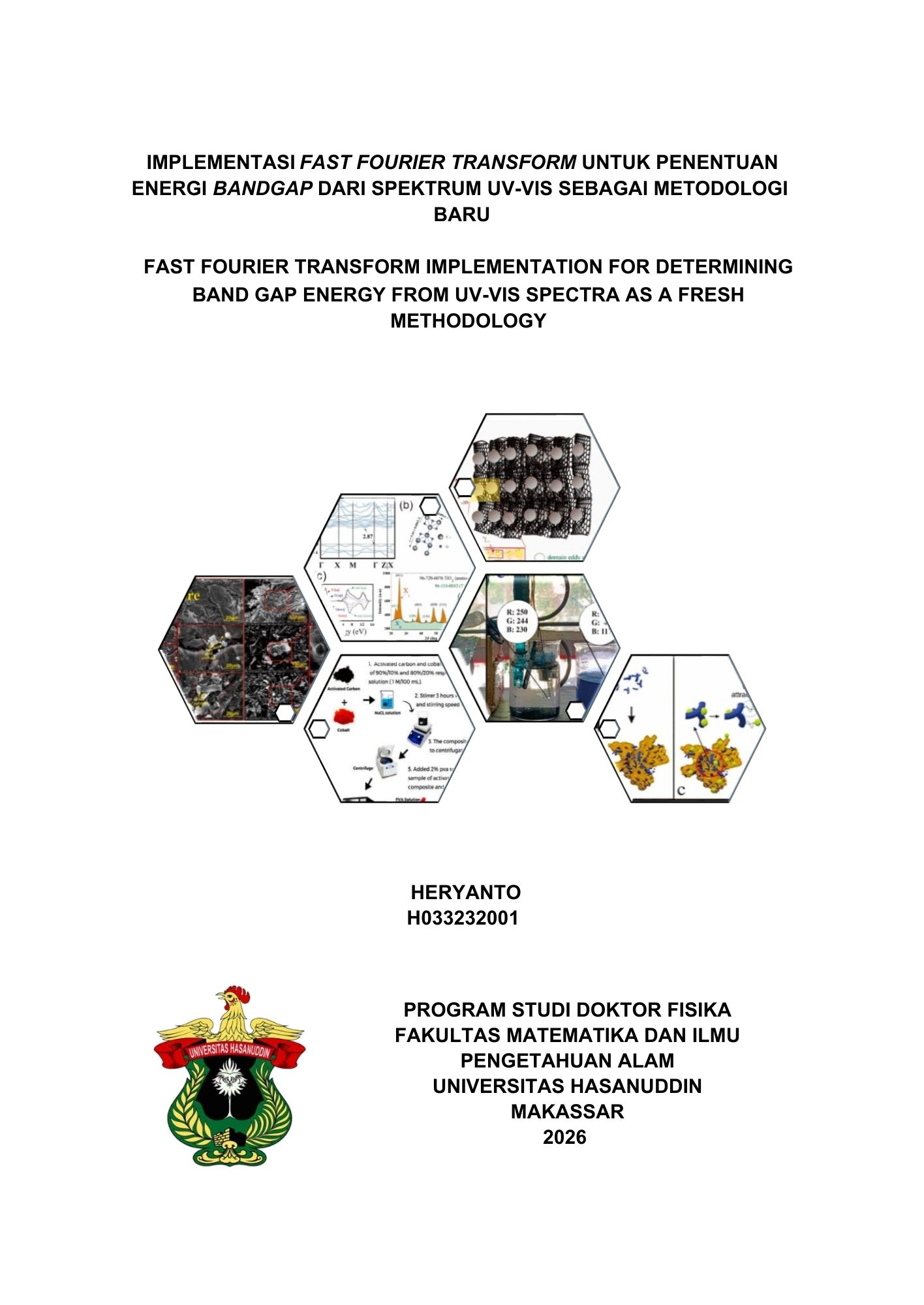
Accurate band gap energy estimation is crucial in optimizing semiconductor material designs for applications such as solar cells, photodetectors, and catalysts. The commonly used Tauc Plot method has limitations in the form of ambiguity in determining straight lines, which is subjective based on the researcher's assessment. This study introduces a new methodology using Fast Fourier Transform (FFT) to analyse UV-Vis absorbance spectra to determine band gap energy quantitatively and minimize subjective analysis errors. The developed methodology involves converting absorbance data into the frequency domain to identify frequency components related to energy band transitions. This FFT calculation strategy is implemented using a MATLAB script to determine the inflection point and maximum absorbance, which correlate with the indirect and direct band gaps, respectively. The reliability of the FFT method was tested on various samples, namely titanium dioxide, cobalt (Co) doped activated carbon (AC), and hydroxyapatite-doped activated carbon (HAp). The results show that the FFT method successfully determines the band gap energy with a high degree of precision. For example, in TiO2, the FFT method produces a value of 3.02 eV, which is closer to the theoretical value than the Kubelka-Munk (KM) and Taylor Expansion (KM/TE) methods, which produce a range of 3.52–3.63 eV. In the AC/Co samples, it was found that AC-Co(10) had the widest band gap (3.20 eV) and showed the best methylene blue (MB) degradation performance of 93.66% over 5 days. Meanwhile, AC/HAp samples produced from mangrove crab shells showed an MB degradation efficiency of 82.05% and optimal hydrogen production with an IoT-based monitoring system. This study concluded that the implementation of FFT provides a new, more objective, and accurate perspective in the optical characterization of semiconductor materials without relying on manual fitting techniques. This methodology has the potential to increase the speed and precision of material analysis on a large scale in various fields of semiconductor and nanotechnology research.
| Item Type: | Thesis (Disertasi) |
|---|---|
| Uncontrolled Keywords: | Band Gap, Fast Fourier Transform, UV-Vis, Tauc Plot, Photocatalyst, Activated Carbon. |
| Subjects: | Q Science > QC Physics |
| Divisions (Program Studi): | Fakultas Matematika dan Ilmu Peng. Alam > Fisika |
| Depositing User: | Unnamed user with username pkl2 |
| Date Deposited: | 08 Sep 2026 02:07 |
| Last Modified: | 08 Sep 2026 02:07 |
| URI: | http://repository.unhas.ac.id:443/id/eprint/57469 |
Actions (login required)

- View Item