

APRILLIA, TIARA (2026) Struktur Komunitas dan Biomassa Padang Lamun Di Pulau Sarappolompo, Kab. Pangkajene dan Kepulauan = Community Structure and Biomass of Seagrass Meadows in Sarappolompo Island, Pangkajene and Islands Regency. Skripsi thesis, Universitas Hasanuddin.
![[thumbnail of Cover]](/55273/1/L011211051-Cover.jpg)
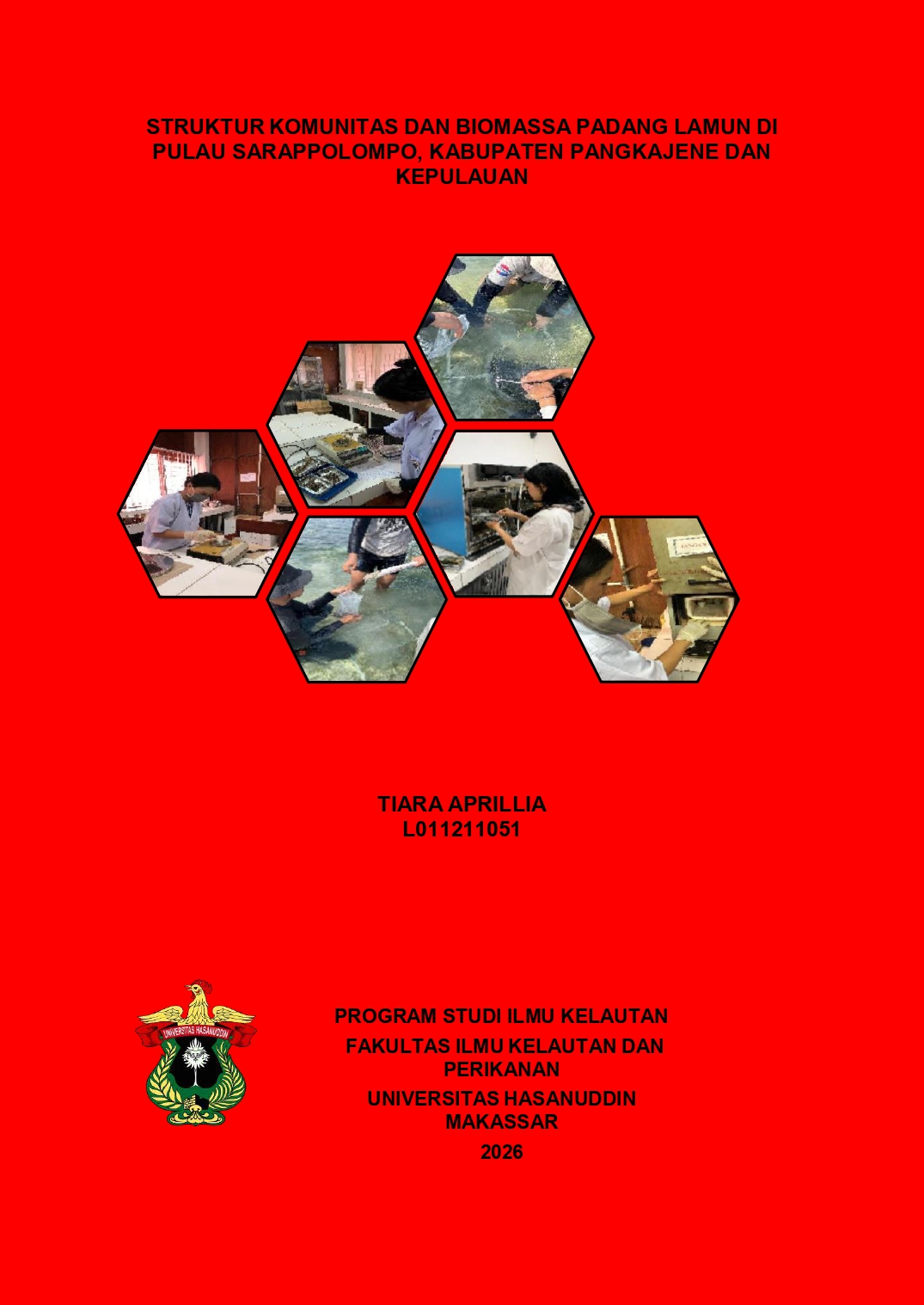
L011211051-Cover.jpg
Download (396kB) | Preview
![[thumbnail of Bab1-2]](/style/images/fileicons/text.png) Text (Bab1-2)
Text (Bab1-2)
L011211051-1-2(FILEminimizer).pdf
Download (347kB)
Text (Dapus)
L011211051-dp(FILEminimizer).pdf
Download (292kB)
Text (Full Text)
L011211051-fulll(FILEminimizer).pdf
Restricted to Repository staff only until 6 February 2028.
Download (949kB)
Abstract (Abstrak)
Background. Seagrass ecosystems are coastal ecosystems that play a crucial role in maintaining the stability of aquatic environments and absorbing and storing carbon. However, information on the community structure, biomass, and carbon stocks of seagrass in the waters of Sarappolompo Island is still limited. Aim. This study aims to analyze seagrass community structure, biomass, carbon stocks, and their relationship to aquatic environmental parameters. Methods. The research was conducted in the waters of Sarappolompo Island at four observation stations using the quadratic transect method. Parameters observed included species composition, density, frequency of occurrence, cover, biomass, carbon stock, and physical and chemical parameters of the waters. Data analysis used correlation analysis, One Way ANOVA analysis, and Tukey analysis. Results. The study showed that there were five species of seagrass, namely Enhalus acoroides, Thalassia hemprichii, Halodule pinifolia, Syringodium isoetifolium, and Cymodocea rotundata, with varying community structures between stations. Station 3 had the lowest density, frequency of occurrence, and cover values influenced by relatively higher current and wave velocities and medium sand substrates. In contrast, Stations 1, 2, and 4 showed better seagrass conditions supported by optimal temperature and salinity, low to moderate current velocities, shallow to medium water depths, and fine sand substrates. Seagrass biomass varied between stations with lower biomass being higher than upper biomass, thus contributing significantly to carbon stocks. Enhalus acoroides was the species with the highest biomass and carbon stocks. Correlation analysis showed a very strong and positive relationship between seagrass density and cover (r = 0.971) and a very strong and negative relationship between seagrass biomass and water depth (r = -0.983). Conclusion. The community structure, biomass, and carbon stocks of seagrass in the waters of Sarappolompo Island are influenced by aquatic environmental conditions, particularly depth, current, and substrate characteristics, and demonstrate the potential of seagrass ecosystems as carbon sinks.
Keyword : Seagrass; Community structure; Biomass; carbon stock; Sarappo Lompo Island.
| Item Type: | Thesis (Skripsi) |
|---|---|
| Uncontrolled Keywords: | Seagrass; Community structure; Biomass; carbon stock; Sarappo Lompo Island. |
| Subjects: | Q Science > Q Science (General) |
| Divisions (Program Studi): | Fakultas Ilmu Kelautan dan Perikanan > Ilmu Kelautan |
| Depositing User: | Rasman |
| Date Deposited: | 21 Apr 2026 07:02 |
| Last Modified: | 21 Apr 2026 07:02 |
| URI: | http://repository.unhas.ac.id:443/id/eprint/55273 |
Actions (login required)

- View Item