

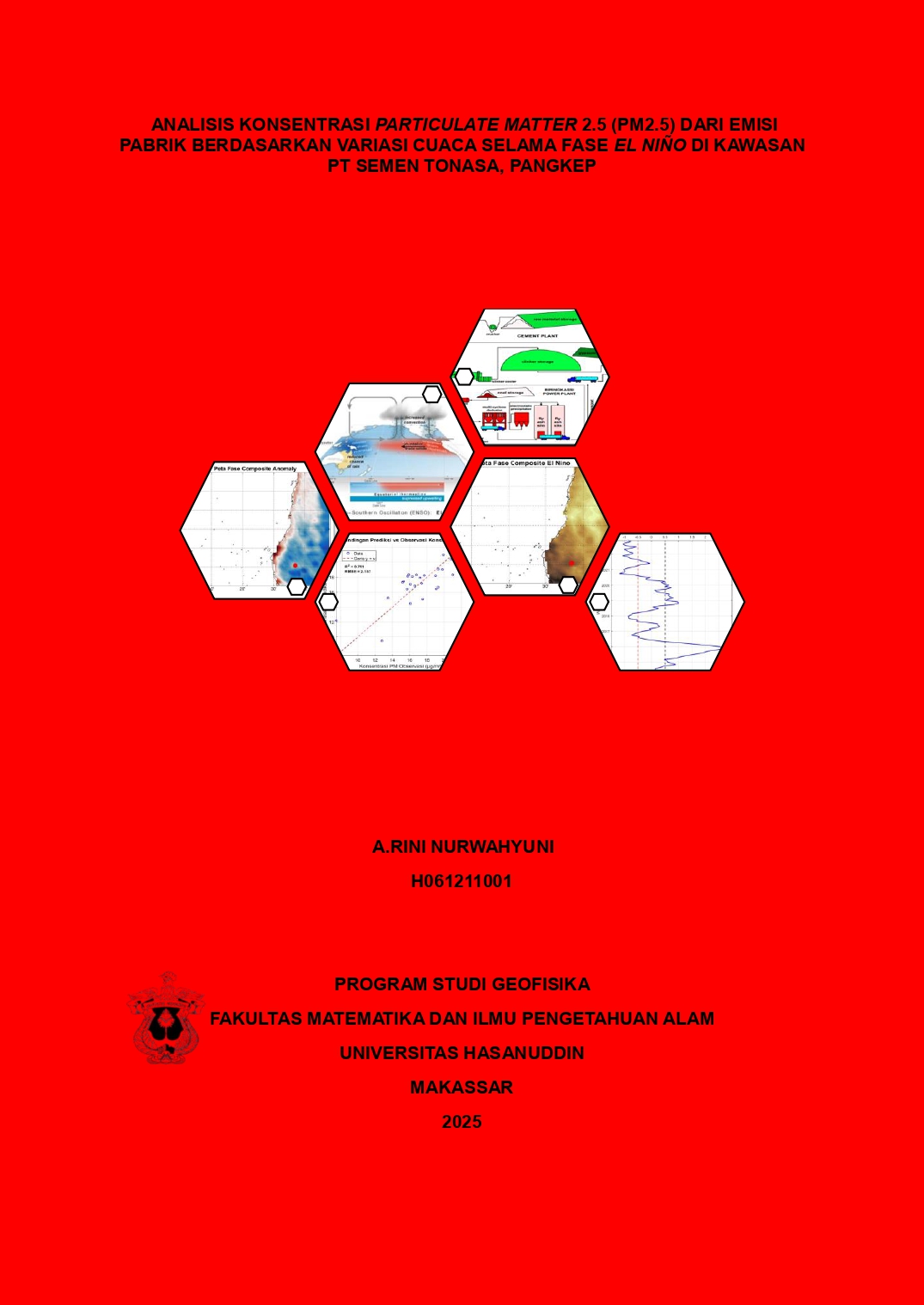
NURWAHYUNI, A. RINI (2025) ANALISIS KONSENTRASI PARTICULATE MATTER 2.5 (PM2.5) DARI EMISI PABRIK BERDASARKAN VARIASI CUACA SELAMA FASE EL NIÑO DI KAWASAN PT SEMEN TONASA, PANGKEP = ANALYSIS OF PARTICULATE MATTER 2.5 (PM2.5) CONCENTRATION FROM FACTORY EMISSIONS BASED ON WEATHER VARIATION DURING EL NIÑO PHASE IN PT SEMEN TONASA AREA, PANGKEP. Skripsi thesis, Universitas Hasanuddin.
![[thumbnail of Cover]](/52064/1/H061211001-Cover.jpg)
H061211001-Cover.jpg
Download (282kB) | Preview
![[thumbnail of Bab1-2]](/style/images/fileicons/text.png) Text (Bab1-2)
Text (Bab1-2)
H061211001-1-2(FILEminimizer).pdf
Download (323kB)
Text (Dapus)
H061211001-dp(FILEminimizer).pdf
Download (192kB)
Text (Full Text)
H061211001-fullll(FILEminimizer).pdf
Restricted to Repository staff only until 22 July 2027.
Download (1MB)
Abstract (Abstrak)
ABSTRACT A. RINI NURWAHYUNI. Analysis of PM2.5 Concentration from Industrial Emissions in Relation to Weather Variability During the El Niño Phase in the PT Semen Tonasa Area, Pangkep (Supervised by Prof. Dr. Halmar Halide, M.Sc) Background. Industrial activities, particularly in the cement industry, are major contributors to fine particulate matter (PM2.5) pollution in the atmosphere. PM2.5 poses significant health risks due to its tiny size, which allows it to penetrate deep into the respiratory tract. The industrial area of PT Semen Tonasa in Pangkep Regency is especially vulnerable to such pollution, particularly during global climate phenomena such as El Niño, which alters weather patterns and affects atmospheric dynamics. Therefore, it is important to understand how weather variations during the El Niño phase influence PM2.5 concentrations in this industrial region. Objective. This study aims to examine the impact of the El Niño phase on the distribution of PM2.5 concentrations and to identify the most influential weather parameters contributing to the increase in particulate levels. Methods. The study employs spatial composite analysis to observe PM2.5 distribution during the El Niño phase, using the Nino 3.4 index classification. In addition, a stepwise multiple regression analysis was conducted to identify the dominant meteorological parameters affecting PM2.5 concentrations. The data used include PM2.5 concentrations, Nino 3.4 index data, and weather data (wind speed, temperature, relative humidity, specific humidity, precipitation, and pressure). Results. The results show that during the El Niño phase, PM2.5 concentrations tend to increase. This rise is influenced by higher temperatures and relative humidity, which are identified as the most significant meteorological parameters, with a significance value of < 0.05 and an R² of 0.711. High temperatures lead to the formation of stable atmospheric layers that inhibit vertical dispersion, while high humidity causes particle growth and prolongs their residence time in the atmosphere, resulting in elevated PM2.5 concentrations. Conclusion. This study shows that the El Niño phase contributes to increased PM2.5 concentrations in the PT Semen Tonasa industrial area, with temperature and relative humidity being the dominant influencing weather factors.
Keyword : PM2.5, El Niño, Cement industry.
| Item Type: | Thesis (Skripsi) |
|---|---|
| Uncontrolled Keywords: | PM2.5, El Niño, Cement industry. |
| Subjects: | Q Science > Q Science (General) |
| Divisions (Program Studi): | Fakultas Matematika dan Ilmu Peng. Alam > Geofisika |
| Depositing User: | Rasman |
| Date Deposited: | 02 Jan 2026 01:27 |
| Last Modified: | 02 Jan 2026 01:27 |
| URI: | http://repository.unhas.ac.id:443/id/eprint/52064 |
Actions (login required)

- View Item