

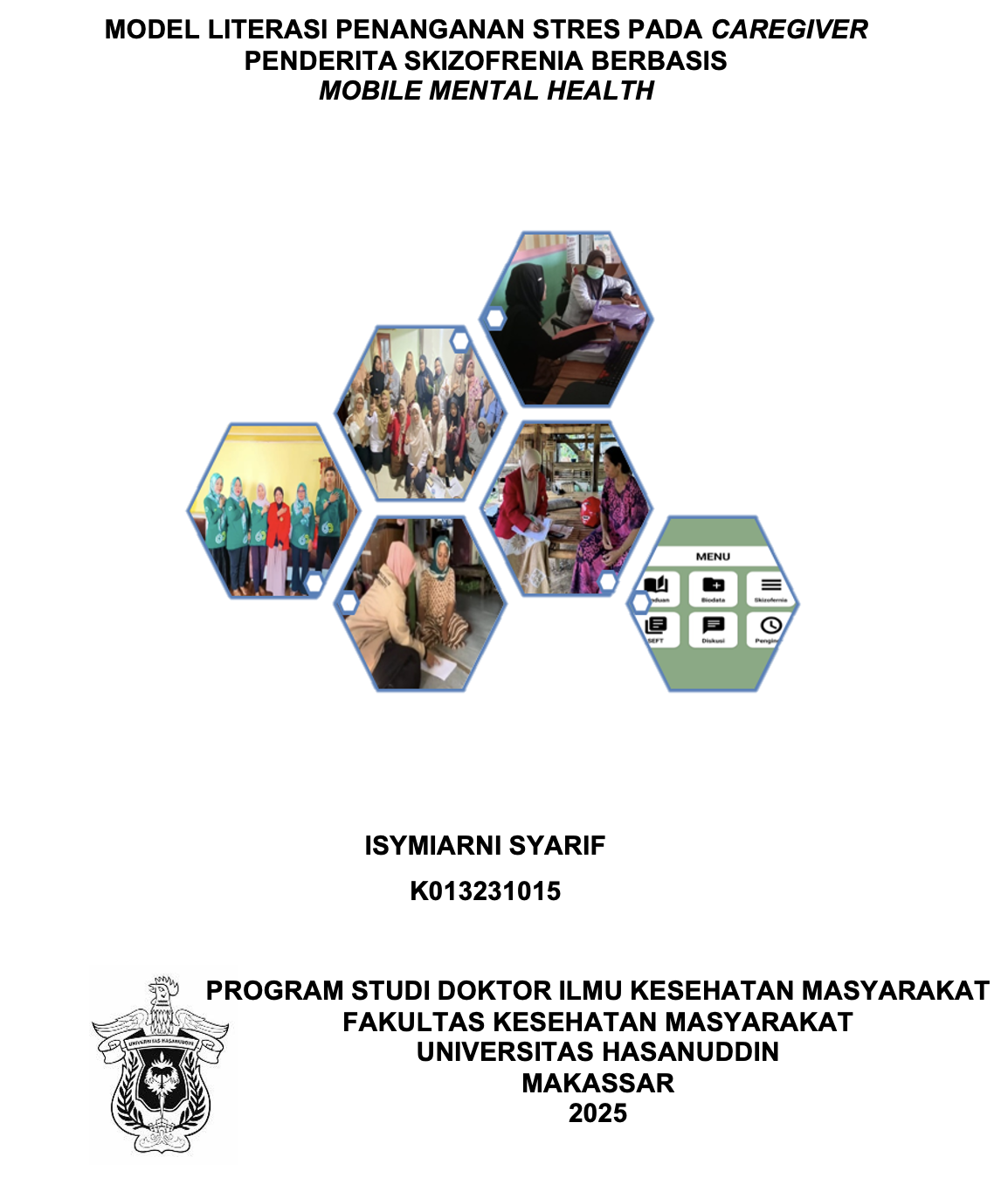
SYARIF, ISYMIARNI (2025) Model literasi penanganan stres pada caregiver penderita skizofrenia berbasis mobile mental health = A Mobile Mental Health-Based Stress Management Literacy Model for Caregivers of Individuals with Schizophrenia. Disertasi thesis, Universitas Hasanuddin.
![[thumbnail of Cover]](/51677/1/K013231015-Cover.png)

K013231015-Cover.png
Download (576kB) | Preview
![[thumbnail of Bab1-2]](/style/images/fileicons/text.png) Text (Bab1-2)
Text (Bab1-2)
K013231015-1-2(FILEminimizer).pdf
Download (1MB)
Text (Dapus)
K013231015-dp(FILEminimizer).pdf
Download (50kB)
Text (Full Text)
K013231015-fulll(FILEminimizer).pdf
Restricted to Repository staff only until 19 August 2027.
Download (2MB)
Abstract (Abstrak)
Background Schizophrenia is a chronic mental disorder with a high relapse rate, often caused by medication non-adherence and limited family involvement. Caregivers play a crucial role in maintaining treatment continuity but often experience stress, which can compromise care quality. Despite this, caregiver needs are often overlooked in mental health interventions, which typically focus solely on patients with schizophrenia. This study aimed to evaluate the effectiveness of a mobile mental health (mMHealth)-based stress in reducing stress among caregivers of individuals with schizophrenia as a strategy to prevent relapse. Methods This quasi-experimental study with a nonequivalent control group design was conducted in three phases. Phase 1 used a cross-sectional design and thematic analysis (via MAXQDA) to identify determinants of caregiver stress among 110 purposively selected caregivers. Statistical analysis included chi-square tests and Partial Least Squares Structural Equation Modeling (PLS-SEM). Phase 2 involved the design and qualitative validation of an mMHealth application (Sajie Care) using the Delphi technique. Phase 3 assessed the intervention’s effectiveness in 64 caregivers experiencing stress using the Wilcoxon signed-rank test and Mann-Whitney U test. Results Most caregivers experienced mild to moderate stress. Significant determinants included age, education level, caregiving burden, knowledge, medication adherence, and social stigma (p < 0.005). PLS-SEM results showed strong positive correlations between stress and caregiving burden (r = 0.672), stigma (r = 0.921), and knowledge (r = 0.909), while social support was strongly negatively correlated (r = −0.872). Thematic analysis revealed five major stress-related themes: emotional burden, coping strategies, caregiving duration, caregiving barriers, and support for patient recovery. The Sajie Care intervention, which included schizophrenia education and SEFT (Spiritual Emotional Freedom Technique) therapy, significantly reduced stress in the intervention group compared to controls (p = 0.014). Conclusions A mobile-based stress management literacy model using Sajie Care is effective in reducing caregiver stress. The integration of digital health interventions into family mental health care, especially in the treatment of schizophrenia, has the potential to improve the mental health of caregivers, thereby preventing relapse in individuals with schizophrenia.
Keyword : Schizophrenia; Caregiver; Stress Management; Health Literacy; Mobile Mental Health; Digital Intervention; SEFT Therapy, Relapse.
| Item Type: | Thesis (Disertasi) |
|---|---|
| Uncontrolled Keywords: | Schizophenia, Caregiver, Stregiver, Stress Management, Health litecy, Mobile mental Health, Digital Intervention. |
| Subjects: | Q Science > Q Science (General) |
| Divisions (Program Studi): | Fakultas Kesehatan Masyarakat > Kesehatan Masyarakat |
| Depositing User: | Rasman |
| Date Deposited: | 17 Dec 2025 03:40 |
| Last Modified: | 17 Dec 2025 03:40 |
| URI: | http://repository.unhas.ac.id:443/id/eprint/51677 |
Actions (login required)

- View Item