

BAHRI, SYAIFUL (2025) Tindak ilokusi yang dilakukan oleh karakter utama dalam film Rush Hour: Analisis Pragmatik = Illocutionary acts performed by the main character in Rush Hour movie: A Pragmatic analysis. Skripsi thesis, Universitas Hasanuddin.
![[thumbnail of Cover]](/51446/1/F041211058-Cover.png)
F041211058-Cover.png
Download (145kB) | Preview
![[thumbnail of Bab1-2]](/style/images/fileicons/text.png) Text (Bab1-2)
Text (Bab1-2)
F041211058-1-2(FILEminimizer).pdf
Download (526kB)
Text (Dapus)
F041211058-dp(FILEminimizer).pdf
Download (447kB)
Text (Full Text)
F041211058-fullll(FILEminimizer).pdf
Restricted to Repository staff only until 17 July 2027.
Download (1MB)
Abstract (Abstrak)
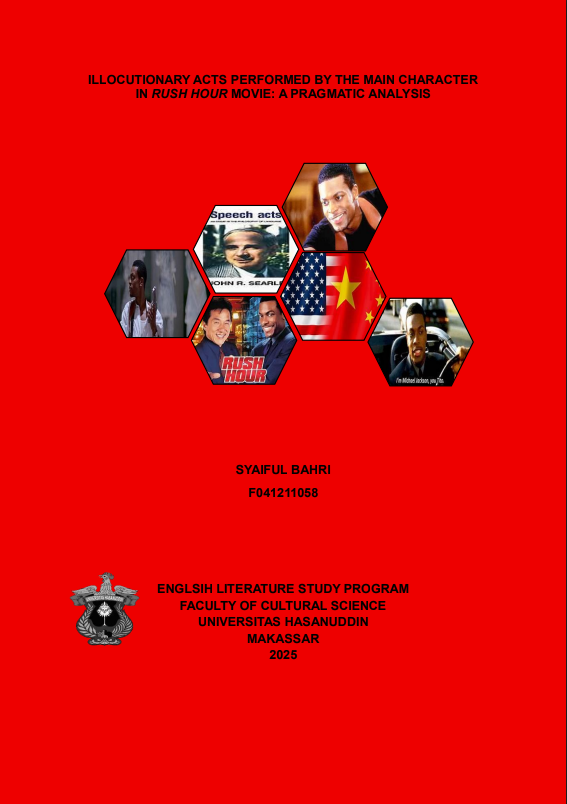
Language in film is never accidental. It reflects character, builds relationships, and forms the plot. Carter’s utterances in Rush Hour are a prime example of how speech can function on multiple levels, making the analysis of illocutionary acts not only interesting but essential. The aims of this research are (1) to identify the type of illocutionary acts performed by the main characters in Rush Hour movie, and (2) to explain the meaning implied in the type of direct and indirect illocutionary acts performed by the main characters in Rush Hour movie. This research employed a mixed-method design, combining a qualitative descriptive approach with basic quantitative analysis. The writer collects the data from the script, then describes the types and the meaning implied in the kind of illocutionary act. This research used theory from John Searle about Illocutionary act classification. Based on the result, from 31 data, the writer finds five types of illocutionary act performed by the main character in Rush Hour movie that are Assertive (9), Directive (14), Commissive (2), Expressive (5), and Declarative (1). Furthermore, the most dominant direct illocutionary act is asking, and the most dominant indirect illocutionary act is warning.
Keyword : speech act; illocutionary act; direct illocution; indirect illocution; Rush Hour.
| Item Type: | Thesis (Skripsi) |
|---|---|
| Uncontrolled Keywords: | Tindak tutur; tindak ilokusi; tindak ilokusi langsung; tindak ilokusi tidak langsung; Rush Hour. |
| Subjects: | P Language and Literature > PR English literature |
| Divisions (Program Studi): | Fakultas Ilmu Budaya > Sastra Inggris |
| Depositing User: | Rasman |
| Date Deposited: | 12 Dec 2025 08:10 |
| Last Modified: | 12 Dec 2025 08:10 |
| URI: | http://repository.unhas.ac.id:443/id/eprint/51446 |
Actions (login required)

- View Item