

RAMADANI. K, PUTRI (2025) POTENSI SENYAWA PEROVSKITE NEODYMIUM(III) CHROMITE (NdCrO3) YANG DISINTESIS MELALUI METODE SOL-GEL PADA PEROVSKITE SOLAR CELL = POTENTIAL OF NEODYMIUM(III) CHROMITE (NdCrO3) PEROVSKITE COMPOUNDS SYNTHEIZED BY SOL-GEL METHOD IN PEROVSKITE SOLAR CELLS. Skripsi thesis, Universitas Hasanuddin.
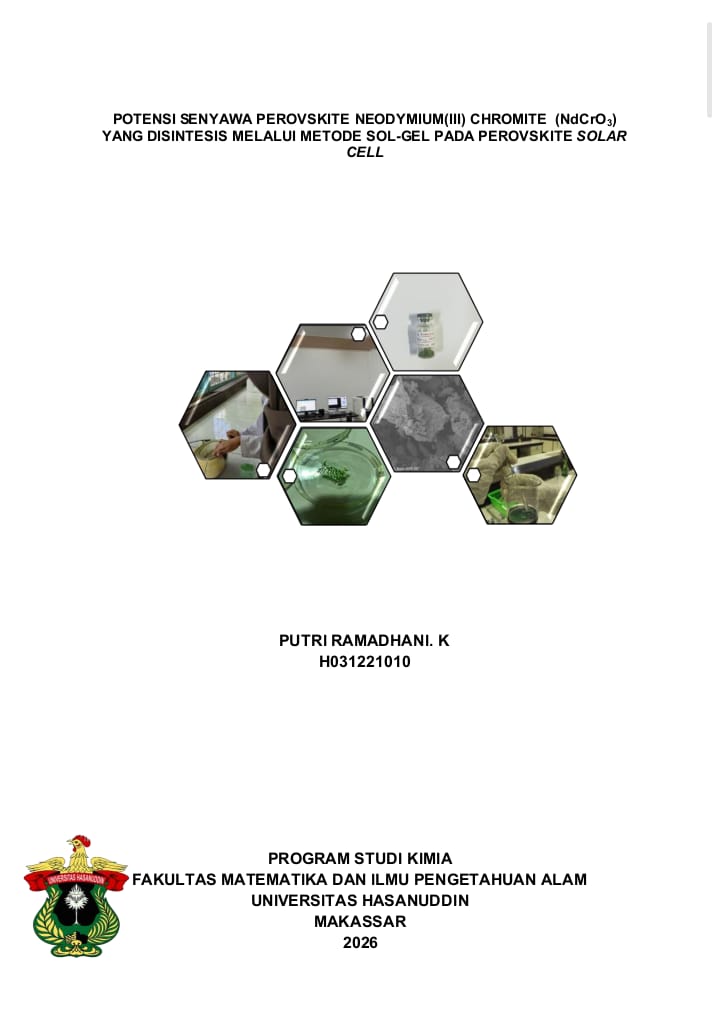
![[thumbnail of COVER]](/57453/1/H031221020-y3C4VbPDMOpZheUQ-20260223133032.jpeg) Image (COVER)
Image (COVER)
H031221020-y3C4VbPDMOpZheUQ-20260223133032.jpeg
Download (40kB)
![[thumbnail of BAB 1-2]](/style/images/fileicons/text.png) Text (BAB 1-2)
Text (BAB 1-2)
H031221020-1-2.pdf
Download (333kB)
Text (DAPUS)
H031221020-dp.pdf
Download (241kB)
Text (FULL TEKS)
H031221020-fullll.pdf
Restricted to Repository staff only until 10 December 2027.
Download (2MB)
Abstract (Abstrak)
Background. The world of materials research and development, particulary in photovoltaic applications, constantly seeks new materials that offer high efficiency, low production costs, and excellent long-term stability. ABX3 perovskite structrured compounds have been a primary focus, but attention is now expanding to inorganic perovskite materials based on transition metals such as Neodymium(III) Chromite (NdCrO3). This compounds is attractive because it possesses semiconducting properties and better stability compared to hybrid organic-inorganic perovskite, positioning it with great potential for further development in Perovskite Solar Cell (PSC) applications. Aim. This study aims to synthesize and characterize the perovskite compound NdCrO3, as well as evaluate its potential as an active material in Perovskite Solar Cell (PSC) applications. Method. NdCrO3 was synthesized using the sol-gel method. Characterization including FTIR, XRD, SEM-EDX, UV-Vis and photovoltaic testing (J-V curve measurement) were carried out on the PSC device to determine its performance. Results. The synthesis was successful with a yield of 75.82%. FTIR and XRD confirmed the formation of orthorhombic structured NdCrO3. SEM-EDX confirmed the elemental composition and NdCrO3 was proven to be a semiconductor with a band gap of 3.4 eV. NdCrO3 was able to absorb light and conduct electric current through photovoltaic testing. Conclusion. NdCrO3 material was successfully synthesized and confirmed as a semiconducting orthorhombic perovskite (based on FTIR, XRD, SEM-EDX, and UV-Vis). Photovoltaic testing demonstrated high efficiency and light absorption, which can conduct electricity.
| Item Type: | Thesis (Skripsi) |
|---|---|
| Uncontrolled Keywords: | ANdCrO3, Perovskite, Photovoltaic, Solar Cell, Sol-gel. |
| Subjects: | T Technology > TD Environmental technology. Sanitary engineering |
| Divisions (Program Studi): | Fakultas Matematika dan Ilmu Peng. Alam > Kimia |
| Depositing User: | Unnamed user with username pkl2 |
| Date Deposited: | 08 Sep 2026 01:35 |
| Last Modified: | 08 Sep 2026 01:35 |
| URI: | http://repository.unhas.ac.id:443/id/eprint/57453 |
Actions (login required)

- View Item